Fourteen steps,
tracked by serial.
Other yards have a process. Ours has 14 steps, three checkpoints, a logbook entry at every station, and a serial number that ties it all together. Boring on paper. Quietly hard to fake in practice.
Same-day reply.
Every form goes straight to a human in Green Bay — no chatbots, no offshore desks. Mon–Fri responses within four working hours.
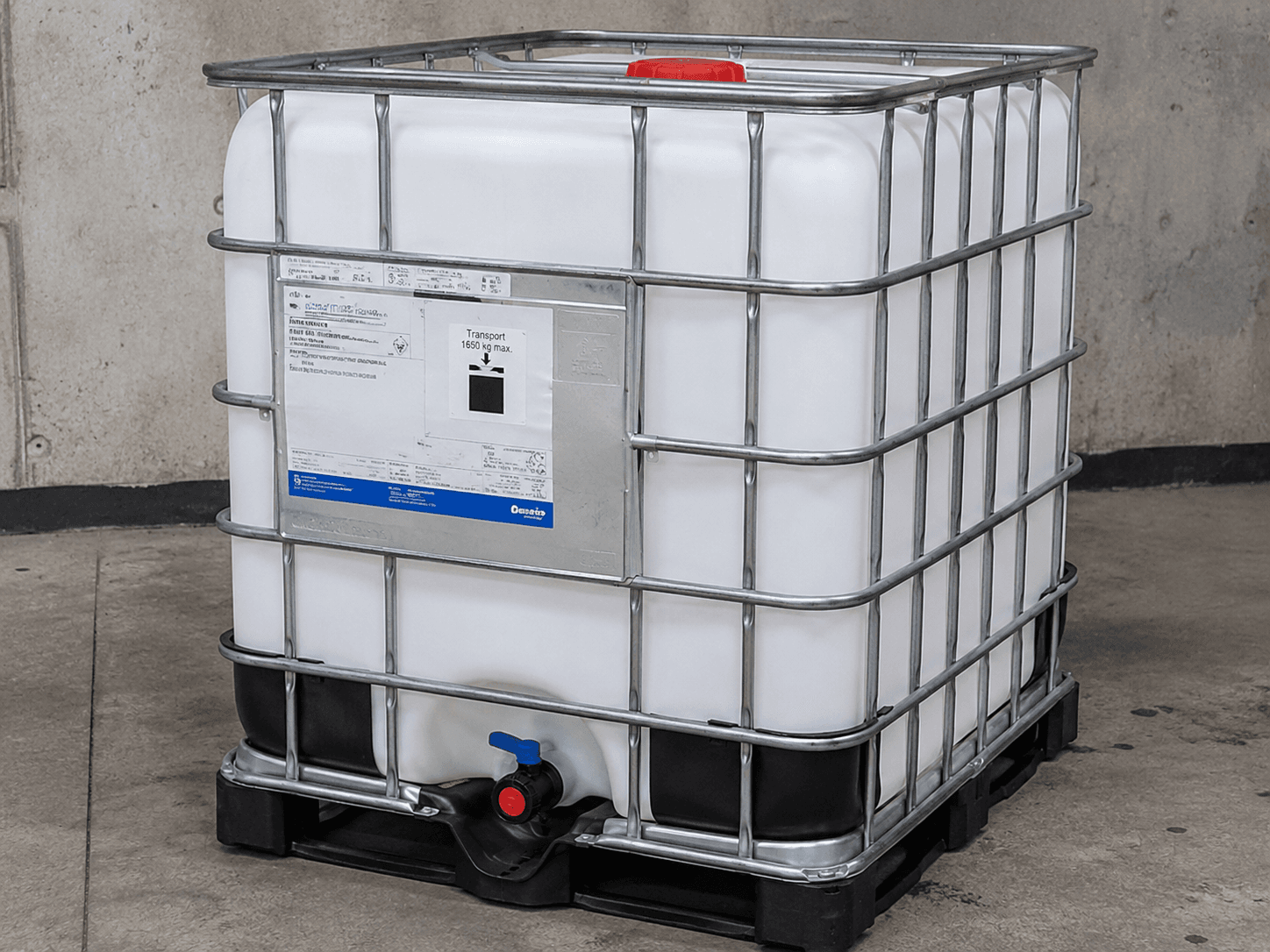
What actually happens to your tote between intake and shipout.
- STEP 01
Intake & log
Photographed on all six sides, serial logged, prior contents declared with SDS attached.
- STEP 02
Triage
Sorted into reconditionable, repurposable, or end-of-life within 48 hours.
- STEP 03
Outer rinse
High-pressure exterior wash to strip labels, dust, and yard debris.
- STEP 04
Cage strip
Bottle removed from cage. Cage inspected; bent struts straightened or replaced.
- STEP 05
Interior caustic wash
Hot caustic recirculation through the bottle for 18–35 minutes depending on prior cargo.
- STEP 06
Hot rinse
Recovered hot water rinse to remove all caustic residual.
- STEP 07
Final RO rinse
Reverse-osmosis water final rinse. RO permeate becomes next cycle’s makeup water.
- STEP 08
Visual + smell check
Trained inspector verifies inside is residue- and odor-free. Yes, by nose. Still the best sensor.
- STEP 09
Leak test
Pressure test at 3 PSI for 5 minutes. Vacuum test follows. Any pressure drop = recycle.
- STEP 10
Gasket / valve refit
New EPDM or NSF gasket. New ball valve if old one shows wear or chatter.
- STEP 11
Cage repaint
Galvanized cage scuff-sanded and recoated where needed.
- STEP 12
Re-stencil
UN/DOT markings, batch ID, our QC stamp, and grade designation.
- STEP 13
Bottle to cage
Reassembled, pallet inspected, banding replaced.
- STEP 14
QC sign-off
Final inspector signature, COA generated, ready to ship.
What the wash actually does.
The caustic step
We run a 2–4% sodium hydroxide solution at 160–180°F through the bottle for 18–35 minutes depending on the prior cargo class. Caustic saponifies organic residue — fats, oils, sugars, adhesives — into water-soluble form so they rinse away with the spent solution.
Why the rinse is the real cleaning
Caustic does the chemistry, but caustic residue in a food-grade tote is a non-starter. We rinse first with recovered hot water (about 150°F), then with fresh reverse-osmosis permeate (about 75°F). Final rinse-water conductivity must fall below our internal threshold or the cycle repeats.
The trace residue check
A trained inspector verifies every reconditioned tote by sight and smell before it leaves the line. Yes, by nose. Twelve years in, the nose remains the most sensitive trace-organic detector we have at the relevant concentrations.
Adhesive-fouled totes
Modern industrial adhesives are engineered to bond persistently to plastic — exactly the property that makes them hard to remove. For adhesive prior contents we add a citrus-terpene pre-soak (~90 min), an extended hot caustic cycle, and a second full RO rinse with extended hold. Some still fail QC and route to repurposing or material recovery.
Cycle time
A standard reconditioning cycle is about 38 minutes per tote on our primary lines, including triage routing and inspection time. The food line runs about 4 minutes slower per tote because of the additional rinse hold. The fast-cycle line (Grade 3 rinse-only) runs at about 11 minutes.
What we don’t do
We don’t use solvents on the food line, ever. We don’t use heat-only cycles (no caustic, no surfactant) and call them reconditioning. We don’t hot-wash totes whose prior contents are unknown into the food pool. The list of don’ts is shorter than the list of dos but matters more.
Documentation that ships with every reconditioned tote.
The paperwork behind the practice.
Hazmat liquid IBC certification
Every reconditioned tote retains its original UN packaging mark and is re-leak-tested.
Food-contact compliance
Replacement gaskets used on our food line are NSF-certified for direct food contact.
B-Corp certification (in renewal)
Second triennial verification underway, projected close Q3 2026.
Quality management
Annual surveillance audits clean since 2019. Recertification 2027.
Small-Quantity Generator
Compliant handling of incidental hazardous residues at intake.
Hazmat employee training
All operators current on DOT Hazmat training as of last refresh.
The ones people ask after their first reply.
How long does a typical reconditioning run take?
About 38 minutes per tote on our primary line, 42 minutes on the food line, 11 minutes on the fast rinse-only line. Throughput across all three lines is roughly 80–90 totes a day.
Can we send our own totes in for reconditioning?
Yes — toll reconditioning is a real part of our business, especially for fleet customers. We’ll quote per-tote pricing and turn-around.
Do you handle hazmat-rated reconditioning?
Yes. The original UN 31HA1 certification is preserved through the process and we re-leak-test. For UN-X (packing group I) we’ll consult on individual cases.
What if a tote fails the leak test?
It gets a yellow tag and re-routes. Most failures are gasket-seat related and resolve on the second pass. Hard failures (bottle puncture, structural deformation) route to material recovery.
Can I watch a tote go through the process?
Yes. Schedule a tour, bring eye and ear protection, and we’ll walk you through end-to-end. Most tours run about 45 minutes.
Send us totes to recondition.
Toll reconditioning is welcome. So is buying our reconditioned stock outright. Pick what fits.