The math beats
the marketing.
Reusing an intermediate bulk container is one of the cleanest single decisions an industrial buyer can make. Below is the carbon, water, plastic, and steel math — published, not whispered.
Same-day reply.
Every form goes straight to a human in Green Bay — no chatbots, no offshore desks. Mon–Fri responses within four working hours.
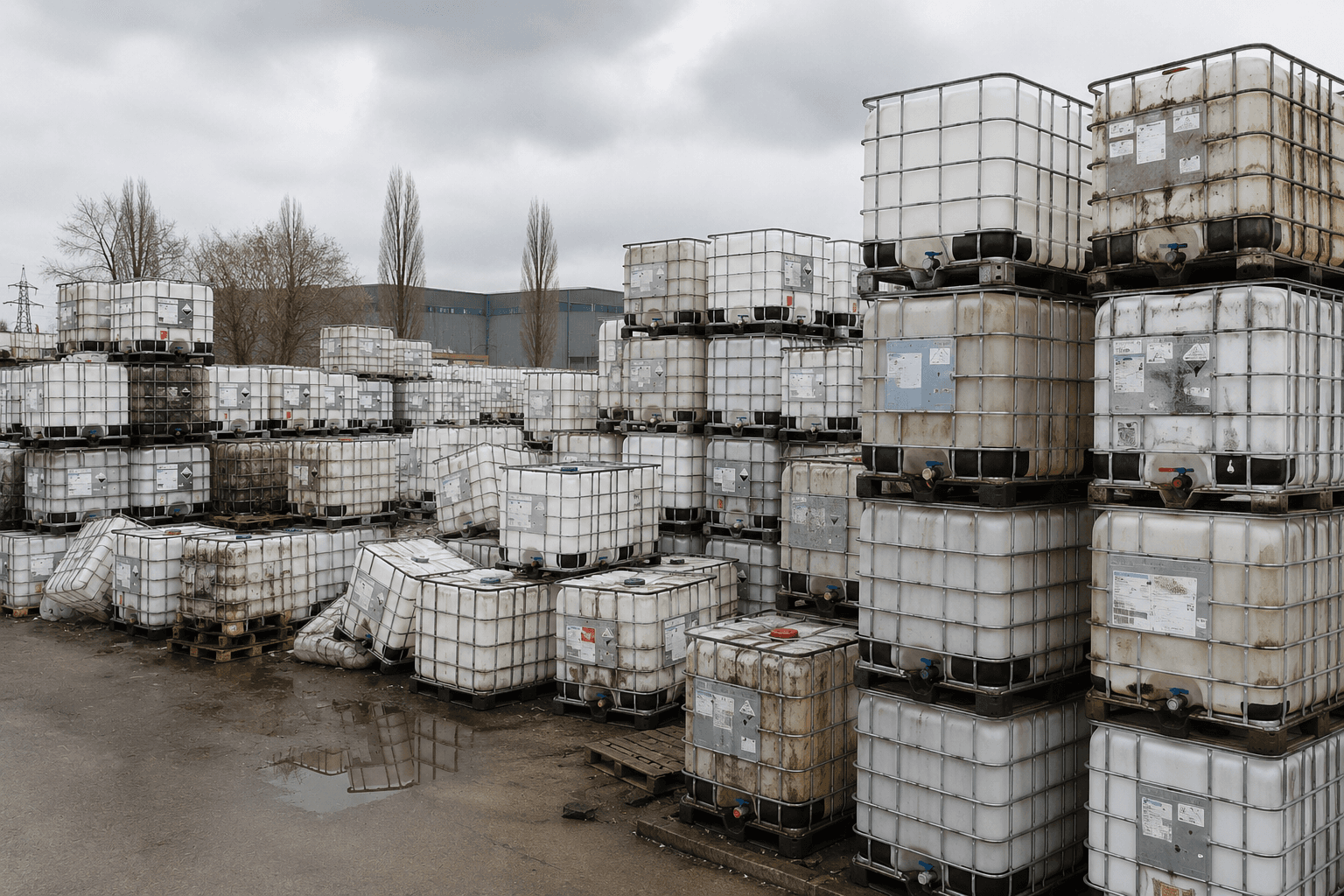
Reconditioning vs. building a brand-new IBC.
| Impact category | New tote (avg.) | Reconditioned (ours) | Δ saved |
|---|---|---|---|
| CO₂e (lb) | 104.6 | 18.2 | −82.6% |
| Virgin HDPE (lb) | 43.0 | 0.4 | −99.1% |
| Virgin steel (lb) | 92.0 | 0.0 | −100% |
| Process water (gal) | 62 | 5.0 (closed-loop) | −92% |
| Energy (kWh) | 78 | 9.1 | −88% |
| Trucking miles (in) | ~1,180 | ~340 | −71% |
New-tote figures are averaged from manufacturer LCA disclosures and trade association reporting (2023–2025). Our figures are measured at the gate using meter readings, fuel logs, and supplier invoices. Methodology PDF on request.
What we’re still trying to fix.
A reconditioned tote isn’t a zero-impact tote. Things still hanging on our wall:
- Caustic. We use less of it than we did three years ago, but we still use it. Trialing enzyme-based wash chemistry for non-food lines in Q4 2026.
- Class-8 fuel. Our nine trucks are diesel. We’re piloting one R99 renewable-diesel contract starting October. Electric Class-8 isn’t a yard-ready option yet.
- Cage paint. The exterior repaint that makes a reconditioned tote look ten years younger still uses solvent-based coatings on the high-traffic industrial line. Water-based coatings are in trials.
- Driver miles for partial loads. A 4-tote pickup is a worse footprint per tote than a 40-tote pickup. Our consolidation routing always gets better; it’s never done.
Year-by-year. Every metric. Nothing rounded up.
| Year | Tanks reconditioned | HDPE avoided (lb) | Steel avoided (lb) | CO₂e avoided (lb) | Water saved (gal) | EoL recycled (lb) |
|---|---|---|---|---|---|---|
| 2017 | 11,420 | 491,060 | 1,050,640 | 986,810 | 708,040 | 54,200 |
| 2018 | 13,950 | 599,850 | 1,283,400 | 1,205,460 | 864,900 | 61,800 |
| 2019 | 15,810 | 679,830 | 1,454,520 | 1,366,260 | 980,220 | 72,400 |
| 2020 | 22,140 | 952,020 | 2,036,880 | 1,913,510 | 1,372,680 | 91,700 |
| 2021 | 20,560 | 884,080 | 1,891,520 | 1,777,180 | 1,274,720 | 88,250 |
| 2022 | 19,890 | 855,270 | 1,829,880 | 1,719,170 | 1,233,180 | 85,400 |
| 2023 | 21,640 | 930,520 | 1,990,880 | 1,870,360 | 1,341,680 | 94,000 |
| 2024 | 23,280 | 1,001,040 | 2,141,760 | 2,011,790 | 1,443,360 | 102,100 |
| 2025 | 24,710 | 1,062,530 | 2,273,320 | 2,135,580 | 1,532,020 | 108,400 |
| 2026 YTD | 11,290 | 485,470 | 1,038,680 | 975,460 | 699,980 | 49,700 |
Numbers derived from intake logs, supplier invoices, and meter readings. Per-tote coefficients use our internal LCA model, validated against published industry ranges. Full methodology PDF on request: info@ibcreconditioned.com.
How we calculate what we publish.
Boundaries
Our LCA uses a cradle-to-gate boundary for new-tote comparisons (from raw resin and ore through finished tote on a manufacturer’s outbound dock). Our reconditioning footprint uses a gate-to-gate boundary (intake through outbound shipment) plus the delta on inbound & outbound trucking.
Data sources
- Electricity: utility billing × regional grid mix from the EPA eGRID database.
- Natural gas: utility billing × EPA emissions factors.
- Class-8 diesel: fuel-card receipts × EPA mobile-source factors.
- Caustic and process chemicals: supplier-published LCA values.
- Water: city meter readings, billed quarterly.
- Avoided manufacturing: published manufacturer LCA disclosures + trade association reporting (2023–2025).
Conservatism choices
Where data ranges overlap, we use the conservative end (smaller savings) so the published number understates rather than overstates. Three examples:
- We credit reconditioned totes with one additional cycle of life beyond the median, not three. The median is what we measure.
- Inbound truck miles to our yard count fully against reconditioning; outbound miles to customers count only as the delta over what a new-tote shipment would have been.
- We exclude rooftop PV from baseline emissions accounting in the comparison tables (we report PV impact separately).
What we exclude
Scope 3 emissions from our staff commute, capital equipment manufacturing, and IT infrastructure. Including those would change the per-tote number by less than 0.4 lb CO₂e.
What we’re working on right now.
The ones people ask after their first reply.
Do you provide carbon-disclosure paperwork for our ESG reporting?
Yes. We can issue a per-shipment carbon avoidance certificate, suitable for Scope 3 reporting, for any order. Includes our methodology, the boundary, and the specific tote serial numbers covered.
Is your LCA third-party verified?
Our methodology has been reviewed by a regional engineering consultancy specializing in industrial LCA. The line-item data is reviewed annually by our outside CPA. We do not currently carry a formal ISO 14064 verification, though that is on our 2027 roadmap.
How does reconditioned compare to new on Scope 3 accounting?
For most buyers, a reconditioned tote shows up as a ~83% reduction in the embodied-emissions portion of Scope 3 packaging. The exact number depends on your baseline assumptions; our certificate provides everything you need to plug into the GHG Protocol packaging guidance.
Are your trucks electric?
No, and not soon. Class-8 electric trucks at our duty cycle do not yet exist in a form we would trust on a Wisconsin winter. We are watching the space. We expect the first viable option around 2028–2029.
What about microplastic shedding from used HDPE?
Real concern. Internal estimates suggest a tote sheds less than 0.6 grams of microplastic across its working life, almost all of it during interior wash where our wastewater capture handles it. We track this in our internal model but have not published per-tote numbers because the measurement uncertainty is still high.
Numbers are public for a reason.
If you are evaluating us for an ESG-sensitive supply chain, we will hand over the underlying data. No NDA gate.